BANCO GALICIA · 2024 · PRODUCT DESIGN
Designing for a habit that already existed
The bank's native Personal Finance Manager. Customers already managed their money in spreadsheets and notebooks; the product brought that habit into the app and automated the hardest part: the credit card.


30-second summary
PROBLEM
Customers were already tracking their finances in Excel, notebooks, and WhatsApp. The bank had all the data but wasn't giving it back to them.
WHAT I DID
I designed the first bank-built PFM in Argentina: automatic transaction categorization, including credit card purchases, with no manual input from the user.
RESULT
It shipped in a Friends & Family launch: 3.5/5 CSAT across 183 responses, validated demand and a prioritized improvement backlog.
THE PROBLEM
Money was managed outside the bank
Galicia had over 3 million active users in the app and one goal: increase usage frequency and cross-sell with other tools. But the app was transactional: you got in, paid, got out.
Research showed customers were already doing the work of managing their finances, just outside: spreadsheets, notebooks, planners and WhatsApp messages to themselves. A manual, error-prone process.
The technical differential was the credit card. In Argentina, between settlements, installments and billing cycles, it's the hardest spending to track automatically. Existing PFMs lived in digital wallets, where that problem doesn't exist. That was the opportunity.
THE RESEARCH
Four profiles, one monthly cycle
Process
- —Qualitative interviews with users aged 18 to 65.
- —Observation of financial routines: how they manage income, savings, and spending.
- —Guerrilla testing at branches with low-fidelity prototypes to validate in real context.
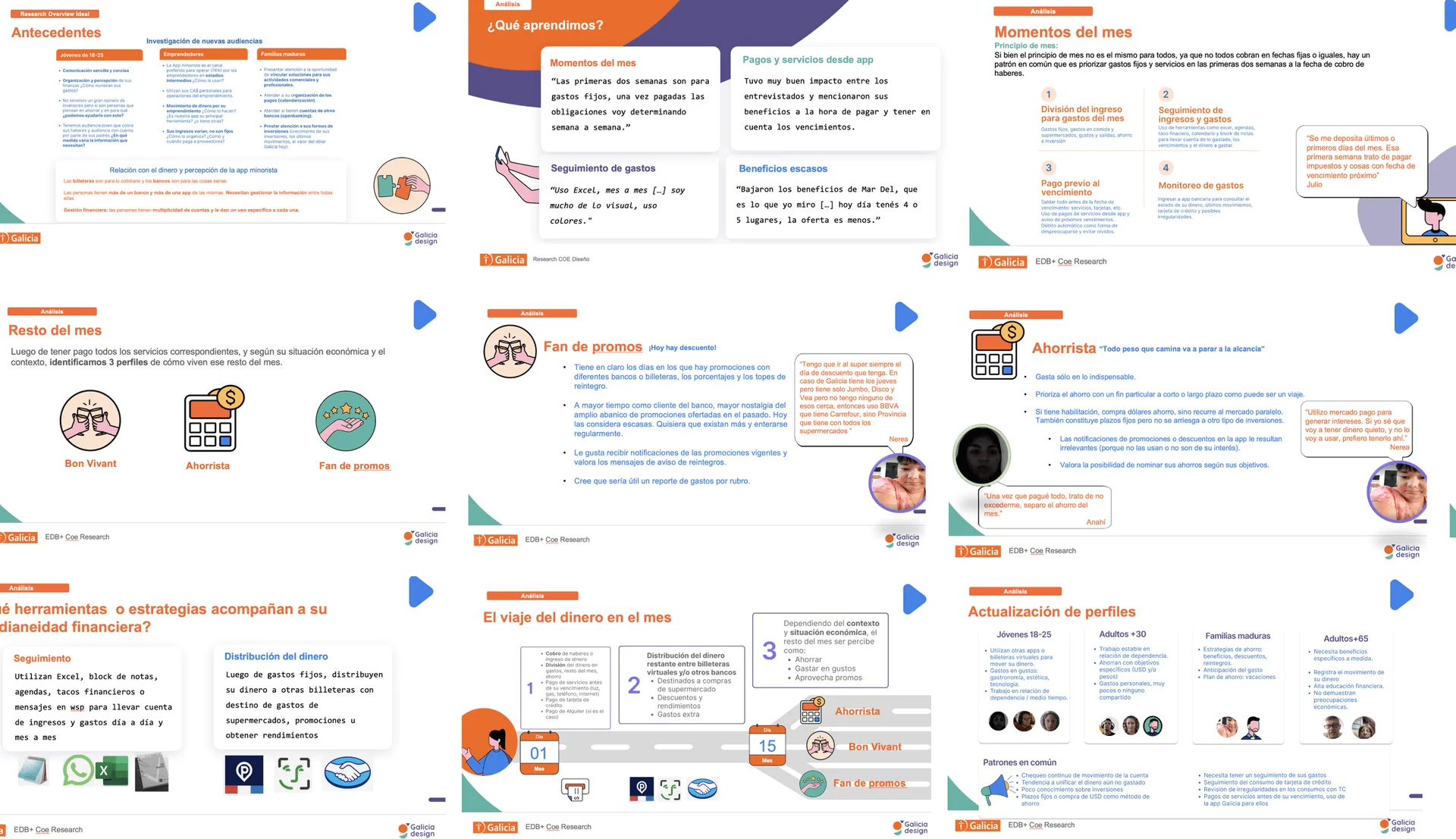
Research overview: background, analysis, and detected profiles.
Four key findings
- 1.Manual management: Excel, notebooks, agendas, WhatsApp.
- 2.Continuous checking: they opened the app several times a day to monitor transactions, especially card activity.
- 3.Monthly pattern: beginning of the month for fixed payments, rest of the month for discretionary spending and savings.
- 4.Low financial literacy around investing: fixed-term deposits or dollar purchases as the dominant savings method.
People were already doing the work. It just had to be made easier.
Four profiles of relationship with money
The Saver
Every peso goes straight to the piggy bank. Spends only on essentials and prioritizes saving toward a goal: a trip, monthly dollars, a fixed-term deposit.
The Bon Vivant
Spends on dining, outings, and pleasures. Uses money as a tool for enjoyment, not planning.
The Promo Hunter
Organizes their spending around discounts, cashback, and benefits. Knows which day which supermarket works with which card.
The Family
Plans vacations, anticipates big expenses, hunts for benefits. Thinks about money long-term and for several people at once.
In the process


THE DECISIONS
Five decisions, and the why behind them
I was the product's only designer. I ran the process end to end and coordinated with research, analysts, developers and business: from interviews and branch testing to the categorization logic and product rules.
Automatic credit card categorization
The finding: users opened the app several times a day to check transactions, mostly credit card. The decision: categorize credit purchases with no manual input. I built the logic with analysts and devs to interpret settlements, installments and billing cycles. The alternative was launching with debit and cash only, like wallet PFMs. The cost: the hardest part of the build, heavily dependent on teams outside design.


Benchmarking outside the banking world
There was no bank PFM in Argentina to compare against. I took references from digital wallets and global fintechs instead of traditional banking patterns. The cost: translating that data viz language for more conservative users with less financial literacy, without losing visual clarity.

Three wireframe iterations for the Investments screen.
Three views in one screen: Income, Expenses, Investments
Tabs in a single screen: everything one gesture away, without clutter. The alternative was a separate section per view, cleaner but with the information scattered. ARS and USD currency selector, essential in the Argentine context.
Accessible iconography and color system from day one
15 categories with simple, encapsulated icons. When the brand colors failed contrast checks, I built an accessible alternative palette. The cost: stepping away from the official palette at a bank where that isn't taken lightly. Other products at the bank use that system today.

Monthly view by default, not weekly or daily
Research showed people think about money in monthly cycles: payday, fixed expenses, the rest. The default respected that mental model. The cost: whoever came to check day-to-day spending was one tap further away.

THE IMPACT
A 3.5 you had to know how to read
Due to BCRA regulatory restrictions, a mass launch wasn't possible from the start. It shipped as a controlled Friends & Family launch, to get real feedback before a general rollout.

What users said
VALUED
Category separation, control over credit cards, visual clarity.
PAIN POINTS
Performance on certain screens, duplicate expenses in specific cases, webview instead of native in some sections.
KEY SUGGESTIONS
Category customization, more flexible filters, downloadable reports.

Synthesis of 183 responses grouped into impressions, features, performance, proposals, and technical issues.
What I took away as a designer
- —Launching with Friends & Family and Hotjar instead of waiting for a closed high-fidelity test gave me more real feedback in less time. I adopted it as a practice for the projects that followed.
- —The CSAT looked low, but qualitative analysis showed the pains were technical (performance, duplicates, webviews), not conceptual. That learning triggered the next case: the semantic CSAT analysis with AI.
WHAT HAPPENED NEXT
What happened next
The project went on pause when Galicia acquired HSBC and product focus shifted to migrating customers. With that migration complete, the bank is now evaluating reintroducing the PFM in other products and reinterpreting the categories.

Contact
Let's talk?
I'm open to opportunities as a Product Designer with an AI focus. I'm also interested in collaborations with social organizations and projects that blend technology with purpose. I'm authorized to work across Mercosur and the European Union, both as a freelancer and as an employee.